2017-05-31

Ink and Bone, by Rachel Caine. New American Library, [2015]

Jess's father is a rough and ruthless London book smuggler. For centuries, the Great Library in Alexandria, Egypt, has sought to own all original books. As a result, there is a thriving - and dangerous - black market in books. So it's surprising that Jess is accepted as a postulant - or student - of the Library. His father smells an opportunity, and encourages him to accept, instructing Jess to send back insider info that will help his smuggling business.

At the Library, Jess, who has learned to trust no one, reluctantly forms close relationships with the other postulants in his group. They unite in their dislike of their mentor, Christopher Wolfe, as, one by one, their ranks are thinned from 30 to 9, when students fail tests and die. Only six will ultimately be accepted and placed into Library service as Scholars, Gardia, Alchemists, or Obscurists.

The Great Library series, which follows in the Harry Potter and Percy Jackson tradition, has a sort of "steampunk" feel. There are elements of old and new in an improbable mix - for example, the printing press has not yet been implemented, but scanned books are delivered electronically by the Library to "blanks" which are, essentially e-book readers. And although most transportation is via steam vehicles (coaches and trains,) people are also sent to distant places via transporters that resemble the "beam me up, Scotty" variety in the Star Trek TV series. Ink and Bone is the first title in what promises to be a suspenseful narrative with much to think about regarding the possession of knowledge. Fans of either series will like this new set of teen heroes.


2016-12-20

Quiet Dell: a Novel, by Jayne Anne Phillips. Scribner, 2013

In the 1930s, the Dutch-born son of an immigrant family chose an unconventional way to raise himself out of poverty. He answered ads in "lonely hearts" columns of the newspapers in various cities, and placed his own ads, as well. He used several aliases to woo and win wealthy widows, persuaded them to empty their bank accounts, and then murdered them.

Quiet Dell is the story of one of the families he victimized, told from the viewpoint of a Chicago journalist and her photographer companion as they pieced together the story of missing widow Asta Eicher and her three children. This particular incident spawned several books and movies about Hermann Drenth, (aka Harry Powers, Cornelius O. Pierson, and A. R. Weaver,) including David Grubb's Night of the Hunter.

For those who enjoy true crime, the author deftly tells the story, revealing details one by one, until the unexpected final Reveal at the end.

2016-06-17

Diamond Head : a novel, by Cecily Wong.  Harper, 2015.

It seems that, ever since Niffenberger's Time Traveler's Wife, authors have been using the device of alternating their points of view between two narrators and/or time points in their novels. In this novel, alternating between the early 20th century and 1964, and in chapters alternately narrated by Amy (mom) and Theresa (daughter), we learn the history of the Leong family in China and Hawaii.

Since I was living in Hawaii in 1964 and am familiar with the places, schools, and social life of that time, I was curious to see how "authentic" the author's descriptions would be. They are, in fact, quite authentic. I have been to many of the places mentioned in the book, and I felt I knew the Leong family, or at least, their friends and relatives. The place names and descriptions, and even the use of local language was spot on. Even so, the concept of the red string connecting actions of the past to events in the future was novel, and the device was effective in "tying" the family history together.

In contrast to Hotel Honolulu, where the characters were hyperbolic and stereotypical, the characters in Diamond Head could have been my real classmates, uncles, and friends. I found it difficult, at first, to keep the characters straight, particularly since one of them was known by at least two names. But once I caught on, the narrative propelled itself to the end, following each thread in the knotty family drama to its unexpected conclusion.


2015-03-19

The Light Between Oceans, by M. L. Stedman. (Scribner, 2012)

Tom is looking for work after his stint in the army in World War I. He believes the lonely job of lighthouse keeper at Janus Rock, a tiny island off the southwestern tip of Australia, will be the perfect place for him, and allow him time and space to recover from the trauma of all the killing - three years between vacations to the mainland. He marries Isabel and takes her to Janus Rock. After several years and three miscarriages, a living baby washes up on shore in a boat with a dead man. Isabel, having lost her third child just two weeks earlier, immediately bonds with the baby and persuades her husband to omit the incident from the lighthouse log - a federal crime - setting in motion the ensuing events in the story.

I'm going to say this is a must-read. It is part romance, part travelogue, part history, part tragedy, and all love story. One of the back jacket blurbs observes, "you stop hoping the characters will make different choices and find you can only watch, transfixed, as every conceivable choice becomes an impossible one." And that about sums it up.

Steadman never puts a foot wrong in building the characters and plot, and creating climaxes at several points within her novel. I got so engrossed in the characters and their stories, I couldn't put the book down. I thoroughly enjoyed the author's detailed descriptions of the island, the light, the protocols, the thoughts and interactions of her characters. I particularly admire the way she leads readers to a conclusion, and then adds a single detail that throws into question everything you thought you knew about the moral dilemma so far. This is an admirable and memorable first novel that will make a great book-group title, because there is so much in it - both from the plot and the craft of the author's writing - to discuss.

2014-12-03

http://find.saclibrarycatalog.org/iii/encore/record/C__Rb1638068?lang=engThe Secret Life of Bees, by Sue Monk Kidd. Penguin, 2003.

Lily, a young, white teen runs away from her abusive father accompanied her black nanny, Rosaleen. She only knows she has to get to Tiburon, South Carolina, because one of the few remaining things she has from her mother is a picture of a black Madonna advertising honey. She believes that if she can get to where that honey was made, she would find someone who knew her mother. She winds up staying with three black sisters who are beekeepers, and who know how to keep secrets, too.

Aside from the bee-keeping lore sprinkled throughout the novel in the form of quotes beginning each chapter, we - and Lily and Rosaleen, and the three sisters, May, June, and August - learn much about history, mothering, and love.

All Our Yesterdays, by Cristin Terrill. Hyperion, 2013

In a converging story revealed alternately by "Marina" and "Em," we learn that a time machine has been invented and is being used by "The Doctor" to travel through history and wipe out all the dictators and despots in order to prevent the atrocities they were responsible for. "The Doctor" has imprisoned Em, because she is trying to use the time machine to travel far enough back to ensure it never gets invented ... but she isn't having much luck. Who is Marina? Who is Em? Who is the Doctor? Bend your mind around these ideas.

2014-11-22

The Shallows: What the Internet is Doing To Our Brains, by Nicholas Carr. W. W. Norton, 2010.

Brains are plastic, and make and erase connections based on need and use.

Reading has changed from puzzlingoutwordsandmeaningwithoutbenefitofspacingandpunctuation at the dawn of writing to consuming headlines on the Internet. This has changed the way our brains work to the point where we can no longer concentrate for more than a few minutes at a time.  Reading a longer work from beginning to end is now a difficult task, because our brains expect to be interrupted often. In other words, we are now consuming a long tail of disparate information pieces, but unable to explore it in enough depth to engage our brains in real thought about any of it.

Do you believe this? I better go online and check it out. BRB.

So as software gets smarter and returns results related to what we're looking for, two things happen: 1. We stop thinking, because the software does that for us (think: point-of-need help, tailored internet search engine results,) and
2. we never see the other results, so therefore they don't exist - or, at any rate, are lost to us. The software filters what we see, based on prior searches, and our field of view gets narrower and narrower.

Carr's work is rife with references to research, and there are more than 30 pages of citations at the end of the book. Whether you agree with him or not, the evidence is compelling for his description of a major change in the way people interact with technology and the Internet: "As we come to rely on computers to mediate our understanding of the world, it is our own intelligence that flattens into artificial intelligence." Scary.

2014-07-26

Pearl of China: a novel, by Anchee Min. Bloomsbury, 2010.

Willow is almost a street-child; she steals and begs under the direction of her father in order to eat. By chance - and quite reluctantly - she becomes friends with the missioner's daughter, Pearl, and the rest of this fictional biography of Pearl Buck follows.

Willow never existed; but by creating this fictional lifelong friend, author Min provided a vehicle for an outsider's view of the circumstances of Pearl's life in China. The narrative follows them from childhood to old age.

Although the facts may be adjusted and the reviews are mixed, I thoroughly enjoyed reading about the missionary experience of Pearl's father and the rest of her family, and about the characters that brought the religious assimilation to life. It reminds me of Kinsolver's Poisonwood Bible, and also of Brooks's Caleb's Crossing, which both also explore missionary zeal.

Min lived through the times described in the setting - Mao's rise and fall - and eventually emigrated to the United States, where she lives today. Like Pearl, her works are banned in China, and for the same reasons. They depict a reality that is uncomfortable.

2014-06-07

The Art Forger: a Novel, by B. A. Shapiro. Algonquin Books of Chapel Hill, 2012

A bold plot to copy art works stolen from the Isabella Stewart Gardner art museum and sell them as originals ... it could have been a standard-issue novel, but in fact, it is much more. In addition to the forgery plot, there are a couple of romantic sub-plots, and a great deal of information about how paintings were made long ago, and - more surprisingly - about techniques used to artificially age forgeries and make them pass all the tests normally used to detect them.

This novel is based on a real incident - the still-unsolved theft of works from the Gardner museum - and adds an interesting side-story of Mrs. Gardner's "relationship" with the painter Degas. I was less interested in the stories of the characters than in the processes of painting, forging, and antiquing art.
The Immortal Life of Henrietta Lacks, by Rebecca Skloot. Crown Publishers, 2010.

In 1950s Baltimore, Henrietta Lacks knows there's something wrong inside her. Poor, and facing racist laws regulating medical care, the cancer grows and finally kills her. Unbeknownst to her or her family, cancerous cells from her cervix were harvested, cultured, and sold to researchers. They were unusual in that they didn't die after 3 generations, as all other harvested cells had done. Due to their genetic uniformity, longevity, and aggressive growth, researchers were able to use Henrietta's cells, known as "HeLa," to study polio vaccine, as well as in AIDS and cancer research, effects of radiation and toxic substances, gene mapping, parvovirus, distemper, and papillomavirus research, and much more.

The author uses interviews with family members to highlight the story of the exploitation of Henrietta's family and the HeLa cells. I listened to the audio edition, and was simply astounded by the two-pronged investigation into the privacy and rights of the family, vs. the benefits that came from using HeLa cells in medical research. The research is ongoing.

2014-02-23

Caleb's Crossing, by Geraldine Brooks. Blackstone Audio, 2011.
Bethia's journal entries begin in the 1600s when she is twelve. Her family has moved from the mainland to an island off the coast of Massachusets, and her father, a preacher, is homeschooling her brother, Makepeace. Bethia performs chores in the same room and easily absorbs the rhetoric, Greek, Hebrew and Latin lessons her older brother cannot grasp. When it becomes obvious she knows more than him, she is banished during lessons, and uses her new free time to explore the island.

On one of her forays, she encounters an Indian boy who, over time, becomes a friend and gives her the name, "Storm Eyes." When her father takes this boy, Caleb, into the household as a student as part of his mission to convert the heathens, the family's way of life is turned upside down. And when it is time for Caleb, Makepeace and others to be sent to the mainland to continue their education, Bethia is indentured to the school's headmaster to help defray the cost of tuition. How she deals with these changed circumstances that alter her life forever is the subject of  the rest of her journal.

This title has some similarities to the author's Year of Wonders: a female narrator with a strong character, lust for learning, and a stubborn streak. Add a disruptive sequence of events, then watch the resulting chaos erupt and settle.

The narrator's measured, yet emotional, reading conveys the frustrations, joys, griefs, and questions Bethia expresses privately in her journal, as one tragedy follows another in this harsh land. I found her stilted enunciation distracting at first, but I believe it was in character - written language is more formal than spoken language, after all. This book might also appeal to teens, despite its length.

2014-01-03

http://www.saclibrarycatalog.org/record=b2230566*engMargot, by Jillian Cantor. Riverhead Books, 2013. 

So, what would have happened if Anne Frank's sister had survived the Bergen-Belsen concentration camp and come to America?

This first-person tale explores this outcome. The premise is that in the Annex, a romantic relationship grew between Margot Frank and Peter. They conspired to take new names and meet in Philadelphia, the City of Brotherly Love, after the war,  marry, and raise a family. Margot is now Margie Franklin.  She is passing as a Gentile legal secretary, hiding her identity and her prison camp tattoo under a cardigan sweater, and calling directory assistance regularly to search for any sign of Peter.

Like Life of Pi, Before I Go To Sleep, and The Double Bind, the borders between fantasy and reality blur and shift. In this case, layers of the Holocaust experience are revealed little by little, as the author probes the feelings, memories (repressed and not,) attitudes of Philadelphians towards Jews, and attitudes of American Jews towards European Jews. The relationship between Margie and Anne is brought into sharp focus when the film Diary of Anne Frank is released, triggering guilty memories surrounding Margo's escape from the prison camp.

It's clear from the outset that this is pure fiction, but it provides Cantor an opportunity to understand her culture, and brings attention to the motivation of some Jewish people to put that part of their lives behind them in America, the Land of the Free.

2013-12-27

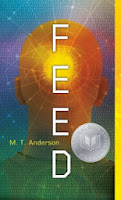
http://www.saclibrarycatalog.org/record=b2228005~S51*engFeed, by M. T. Anderson. Candlewick Press, 2012.

It is a hundred years in thefuture, and people no longer walk around with their faces in their mobile devices. Instead, everyone has implanted chips that stream their feeds 24/7: news, entertainment, advertisements, chat... Google and Wikipedia are always available.

For a lark, a group of friends decides to go to the moon for the day, but it turns out that "the moon sucks." Titus, the main character meets Violet on the moon, but she heretically resists the feed and, by actually having original thoughts and opinions, becomes the catalyst for the events that occur when the feed becomes corrupted.

This is a satirical, hyperbolic and frightening look at what could happen if the only information you get is what you've selected for your feed, and what your "smart" feed thinks you will like, based on prior choices. The dialogue captures teen conversational style accurately. It's a topic also covered more seriously in Eli Pariser's The Filter Bubble.

2013-11-30

The Song of the Quarkbeast, by Jasper Fforde.  Harcourt, 2011.

Because I enjoyed the author's Eyre Affair, I decided to try this teen fantasy, which is the second title in the Chronicles of Kazam series.

Magic is finally on the rise after a period of decline, and the two major houses are in a struggle to control it. One house, Kazam, is being managed temporarily by a gutsy teen Orphan, due to the enchanted absence of its real administrator. The other is nefariously engaged, with King Snodd's help, in rigging the competition so as to give control of all magic to the throne.

The plot is thin - but OK. The punniness is rampant, with character names like Youthful Perkins, Tiger Prawns, Half Price and Full Price, Boolean Smith, and Daredevil Nuttjob, and a setting called The Ununited Kingdom. The tension around the magic building contest isn't really tense, and the comedic mingling of the trappings of traditional magic (flying carpets, levitation, invisibility, turning to stone) with modern conventions like electricity, microwave ovens, cell phones, can be jarring at times. It would probably appeal to younger teens, both boys and girls, who get a charge out of puns, snarkiness, and wordplay.

2013-11-05

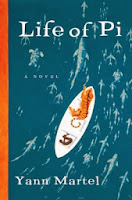
http://www.saclibrarycatalog.org/record=b1606674~S51Life of Pi, by Yann Martel. Harcourt, 2002.

Elegantly set up and eloquently told, the life of an Indian teen changes catastrophically when the freigher moving him and his family and some zoo animals suddenly sinks in the middle of the Pacific Ocean.

Having grown up as the son of a zookeeper in India, and having the freedom to explore the three major religions (Catholicism, Judaism, and Islam), he brings all this experience to bear while learning to survive in 40' lifeboat with a zebra, hyena, orang-utan, and Mr. Parker, a tiger.

What I found fascinating is his application in the lifeboat of everything he had learned from his father as an animal keeper: the habits, the natures, of the animals in the boat, and the psychology required to remain the alpha male in charge of the menagerie. He made mistakes and learned from them. He faced illness and despair and surmounted them by calling on what he learned from his religious education as well as the responsibility learned as a keeper of animals.

The story is compelling and the zinger at the end made me want to go back and try to figure out what I missed!

2013-10-06

Of Triton, by Anna Banks. Feiwel and Friends, 2013.

In this sequel to the author's Of Poseidon, Emma, now deeply in love with Galen, is drawn into Syrena politics as the descendants of Poseidon struggle with the descendants of Triton. In the first place, although she is the daughter of a Poseidon princess, she is also half-human, an abomination under Syrena law. Secondly, Galen is a prince of Triton's house, and marriage beetween them is forbidden. Thirdly, she is being proposed as a wife for Galen's brother to satisfy a law that requires the heir to marry a princess of the other house every third generation in order to keep harmony among the Syrena.
Plot twists galore drive this novel to its novel conclusion!
Cooking For Geeks : real science, great hacks, and good food, by Jeff Potter. O'Reilly, 2010.

Everything you ever (didn't) want to know about food and cooking, but now that you do, you'll never view a meal in the same way again. Potter provides the whys, hows, and stories behind many of the foods and condiments we use every day. It takes a bit of concentration to read and understand the explanations, but the recipes I tried were tasty. Homemade ginger ale, anyone?

2013-09-02

Heart of Stone : a Verity Gallant Tale by M. L. Welsh. David Fickling Books, 2012.

This continues the children's tale begun in Welsh's Mistress of the Storm. Verity and her friends have enjoyed a fine summer, but in the fall, strange things again occur: the ground is eroding, and fine sand infiltrates all aspects of village life, even to erasing the words from ancient books in the library. The sand comes from the body of the Earth Witch, who was crushed into a million pieces by the Wind Witch many years ago, and who is on the verge of re-assembling herself. Once again, Verity and her friends must try to find the cause and stop the damage.

I love the way the author brings the library into the novel as the command center where the characters do research, maintenance on the damaged texts, and plot their next moves in the defeat of the Earth Witch's nefarious plans. The children are smart, have believable skills and feelings, and there's a hint of a budding romance in the works, too.


Eyre Affair
The Eyre Affair, by Jasper Fforde. Viking, 2002.

Thursday Next is a Crimean War veteran and Litera Tec employee responsible for maintaining the integrity of classic literature in England. Because time-travel is common, it is possible to change the texts, thereby altering plots and characters. Thursday tracks down all such incidents and arranges for the arrest of the perps. The invention of the Prose Portal complicates matters by allowing real people to slip into the worlds of the novels and interact with its characters.

Part sci-fi, part mystery, part punny literary folly, this rollicking read is the first of the Tuesday Next novels.

2013-08-09

Once, by Morris Gleitzman, narrated by the author.  2010. Bolinda Audio.

Placing Felix in a Catholic orphanage for protection was the last selfless and difficult act of his Jewish parents on the eve of Nazi takeovers in Poland. Even after 3 years, Felix is confident they will be back to take him home. A book-burning incident in the orphanage courtyard causes Felix to run away to find his parents (bookstore owners) and warn them to hide their books.

Felix is young - maybe about 9 years old - and he is completely unaware of Hitler's persecution of the Jews in Poland. His rationalizations become a little tedious because of the tenacity with which he holds on to them, but they are consistent with his age and his experiences.

Felix is also a storyteller. Each chapter begins with the word, "Once," and this device neatly ties together the episodes in his odyssey to find his parents. The author/narrator completely captures the essence of the character's innocence with his expressive voice, but does not gloss over the atrocities Felix encounters. Ultimately, the open ending is hopeful.

This book could be read or listened-to by both boys and girls, and would be a great enrichment title for a unit on the Holocaust.