2013-12-27

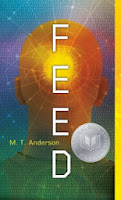
http://www.saclibrarycatalog.org/record=b2228005~S51*engFeed, by M. T. Anderson. Candlewick Press, 2012.

It is a hundred years in thefuture, and people no longer walk around with their faces in their mobile devices. Instead, everyone has implanted chips that stream their feeds 24/7: news, entertainment, advertisements, chat... Google and Wikipedia are always available.

For a lark, a group of friends decides to go to the moon for the day, but it turns out that "the moon sucks." Titus, the main character meets Violet on the moon, but she heretically resists the feed and, by actually having original thoughts and opinions, becomes the catalyst for the events that occur when the feed becomes corrupted.

This is a satirical, hyperbolic and frightening look at what could happen if the only information you get is what you've selected for your feed, and what your "smart" feed thinks you will like, based on prior choices. The dialogue captures teen conversational style accurately. It's a topic also covered more seriously in Eli Pariser's The Filter Bubble.

2013-11-30

The Song of the Quarkbeast, by Jasper Fforde.  Harcourt, 2011.

Because I enjoyed the author's Eyre Affair, I decided to try this teen fantasy, which is the second title in the Chronicles of Kazam series.

Magic is finally on the rise after a period of decline, and the two major houses are in a struggle to control it. One house, Kazam, is being managed temporarily by a gutsy teen Orphan, due to the enchanted absence of its real administrator. The other is nefariously engaged, with King Snodd's help, in rigging the competition so as to give control of all magic to the throne.

The plot is thin - but OK. The punniness is rampant, with character names like Youthful Perkins, Tiger Prawns, Half Price and Full Price, Boolean Smith, and Daredevil Nuttjob, and a setting called The Ununited Kingdom. The tension around the magic building contest isn't really tense, and the comedic mingling of the trappings of traditional magic (flying carpets, levitation, invisibility, turning to stone) with modern conventions like electricity, microwave ovens, cell phones, can be jarring at times. It would probably appeal to younger teens, both boys and girls, who get a charge out of puns, snarkiness, and wordplay.

2013-11-05

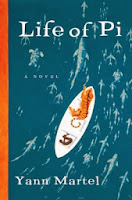
http://www.saclibrarycatalog.org/record=b1606674~S51Life of Pi, by Yann Martel. Harcourt, 2002.

Elegantly set up and eloquently told, the life of an Indian teen changes catastrophically when the freigher moving him and his family and some zoo animals suddenly sinks in the middle of the Pacific Ocean.

Having grown up as the son of a zookeeper in India, and having the freedom to explore the three major religions (Catholicism, Judaism, and Islam), he brings all this experience to bear while learning to survive in 40' lifeboat with a zebra, hyena, orang-utan, and Mr. Parker, a tiger.

What I found fascinating is his application in the lifeboat of everything he had learned from his father as an animal keeper: the habits, the natures, of the animals in the boat, and the psychology required to remain the alpha male in charge of the menagerie. He made mistakes and learned from them. He faced illness and despair and surmounted them by calling on what he learned from his religious education as well as the responsibility learned as a keeper of animals.

The story is compelling and the zinger at the end made me want to go back and try to figure out what I missed!

2013-10-06

Of Triton, by Anna Banks. Feiwel and Friends, 2013.

In this sequel to the author's Of Poseidon, Emma, now deeply in love with Galen, is drawn into Syrena politics as the descendants of Poseidon struggle with the descendants of Triton. In the first place, although she is the daughter of a Poseidon princess, she is also half-human, an abomination under Syrena law. Secondly, Galen is a prince of Triton's house, and marriage beetween them is forbidden. Thirdly, she is being proposed as a wife for Galen's brother to satisfy a law that requires the heir to marry a princess of the other house every third generation in order to keep harmony among the Syrena.
Plot twists galore drive this novel to its novel conclusion!
Cooking For Geeks : real science, great hacks, and good food, by Jeff Potter. O'Reilly, 2010.

Everything you ever (didn't) want to know about food and cooking, but now that you do, you'll never view a meal in the same way again. Potter provides the whys, hows, and stories behind many of the foods and condiments we use every day. It takes a bit of concentration to read and understand the explanations, but the recipes I tried were tasty. Homemade ginger ale, anyone?

2013-09-02

Heart of Stone : a Verity Gallant Tale by M. L. Welsh. David Fickling Books, 2012.

This continues the children's tale begun in Welsh's Mistress of the Storm. Verity and her friends have enjoyed a fine summer, but in the fall, strange things again occur: the ground is eroding, and fine sand infiltrates all aspects of village life, even to erasing the words from ancient books in the library. The sand comes from the body of the Earth Witch, who was crushed into a million pieces by the Wind Witch many years ago, and who is on the verge of re-assembling herself. Once again, Verity and her friends must try to find the cause and stop the damage.

I love the way the author brings the library into the novel as the command center where the characters do research, maintenance on the damaged texts, and plot their next moves in the defeat of the Earth Witch's nefarious plans. The children are smart, have believable skills and feelings, and there's a hint of a budding romance in the works, too.


Eyre Affair
The Eyre Affair, by Jasper Fforde. Viking, 2002.

Thursday Next is a Crimean War veteran and Litera Tec employee responsible for maintaining the integrity of classic literature in England. Because time-travel is common, it is possible to change the texts, thereby altering plots and characters. Thursday tracks down all such incidents and arranges for the arrest of the perps. The invention of the Prose Portal complicates matters by allowing real people to slip into the worlds of the novels and interact with its characters.

Part sci-fi, part mystery, part punny literary folly, this rollicking read is the first of the Tuesday Next novels.

2013-08-09

Once, by Morris Gleitzman, narrated by the author.  2010. Bolinda Audio.

Placing Felix in a Catholic orphanage for protection was the last selfless and difficult act of his Jewish parents on the eve of Nazi takeovers in Poland. Even after 3 years, Felix is confident they will be back to take him home. A book-burning incident in the orphanage courtyard causes Felix to run away to find his parents (bookstore owners) and warn them to hide their books.

Felix is young - maybe about 9 years old - and he is completely unaware of Hitler's persecution of the Jews in Poland. His rationalizations become a little tedious because of the tenacity with which he holds on to them, but they are consistent with his age and his experiences.

Felix is also a storyteller. Each chapter begins with the word, "Once," and this device neatly ties together the episodes in his odyssey to find his parents. The author/narrator completely captures the essence of the character's innocence with his expressive voice, but does not gloss over the atrocities Felix encounters. Ultimately, the open ending is hopeful.

This book could be read or listened-to by both boys and girls, and would be a great enrichment title for a unit on the Holocaust.

2013-08-04

Daughter of Smoke and Bone, by Lainie Taylor, narrated by Khristine Hvam. Hachette Audio, 2011.

This Young Adult sci-fi/fantasy takes place (mostly) in Prague, where Karou, raised by a foster family, tries hard to fit in with the rest of her friends. She's in school and studying art, but runs errands in other dimensions to collect teeth for her foster father, a wizard and wish-giver. He uses the teeth for ... hmmm ... it's unclear, but it has something to do with the war on Seraphs. After opening a forbidden door in his workshop and wandering through, Karou is catapulted into the war and a relationship with Akiva, an enemy Seraph, who seems strangely familiar, but who puts her and her family in grave danger.

The dialog is believable, and the character description is vivid. There is a sensuous love scene near the end, and a surprising plot twist that opens the way for the sequel (Days of Blood and Starlight). Definitely for older teens, because of some graphic violence and sex.

2013-07-04

Spectrums  : our mind-boggling universe from infinitesimal to infinity, by David Blatner. Walker & Co., 2012.

Size, Speed, Light, Number, Heat & Time - from the smallest subatomic particles to the ever-expanding universe; from the coldest "absolute zero" to unimaginably hot temperatures - Blatner leads us through abstruse and theoretical science in a way that makes it understandable.

This isn't something I would normally have picked up; it was recommended to me by a teen. He was at such a loss to explain it, but so obviously engaged with the ideas, I had to give it a try. And I'm grateful for the recommendation. "Spectrums" is definitely worth reading!

It is a summary of scientific information about the extremes in our universe that will shake your belief in everything you have been taught or have ever experienced. Things behave unexpectedly at the extremes of each spectrum, and the explanations are fascinating.  My particular "aha!" chapter was the last one: Time. Blatner hints at parallel universes, time travel, and other science "fictions" that turn out to be ... possible!

2013-06-22

Six Degrees: Our Future on a Hotter Planet, by Mark Lynas. National Geographic, 2008

Ever since "The Secret Life of Dust" introduced me to "readable non-fiction", I've enjoyed learning about different aspects of our Earth. One of my co-workers recommended "Six Degrees" and said it would be scary and shocking. It was. But it was also very one-sided, with very little mention of competing theories.

Five years ago, when the book was published, the average temperature of the earth was already at least 1 degree hotter. Degree by degree, Lynas takes us through changes that will occur as the earth's average temperature rises, until by the time it reaches 6 degrees, much of earth will be desertified, and people will be warring for the few remaining habitable places. Relying heavily on computer modeling scenarios and other research, the evidence is compelling. Not until the very end does the author propose measures that can be undertaken to slow the process. Seven years later, none of them has been implemented, and we are rapidly approaching the tipping point of a carbon dioxide "feedback loop" that will make the heating process not only accelerate, but become irreversible.

2013-02-16

The One and Only Ivan, by Katherine Applegate. Harper, 2011

Ivan is a silverback gorilla. He lives in a glass cage in a shopping mall, and is part of a mall circus that gives performances several times a day, 365 days a year. When the circus revenue drops and Stella, the aging elephant develops a disabling foot infection, the owner brings in Ruby, a baby elephant,  hoping the cute baby will bring in new customers.

Ruby doesn't adjust well, revenue doesn't increase, and the future of the circus is bleak. With the help of custodial staff, Ivan, who loves to paint pictures, takes matters into his own great hands.

This is not a maudlin story, by any stretch; it is an emotionally powerful paean to animal welfare with appealing characters, both animal and human. It is the 2013 winner of the Newbery Award for children's books.

2013-01-22

Before I Go To Sleep, by S.J. Watson. Harper, 2011.

Imagine that, because of a tragic accident, you are unable to retain new memories. That is, the memory of everything that you do today and of what happens to you today will be gone tomorrow. Imagine this condition continuing for 20 years!

Christine doesn't know how the old woman in her mirror could possibly be herself, and has to be re-instructed every morning that the man in her bed is no stranger, but Ben, her husband of 22 years. She has no memory of the journal she's been keeping recently, but is dependent on her doctor's daily phone call reminding her of its existence and location. Nor does she know why the note in the front of the journal warns, "Don't trust Ben."

By reviewing the previous journal entries through Christine's eyes and reading the new ones as she writes them, we - and Christine - gradually piece together the story of the accident that caused her amnesia and the chilling secret she ultimately discovers.

This is a great discussion book on many levels: the frustrations of an amnesia victim, the use of the journal and of time passing to advance the plot, the ethics of manipulating the world of the victim, and the completely unexpected climax.

2012-12-01

The Information Diet, by Clay A. Johnson. O'Reilly, 2012.

The jacket blurb states the problem:
The modern human animal spends upwards of 11 hours out of every 24 in a state of constant consumption. Not eating, but gorging on information ceaselessly spewed from the screens and speakers we hold dear. Just as we have grown morbidly obese on sugar and flour - so, too, have we become gluttons for texts, instant messages, emails, RSS feeds, downloads, videos, status updates, and tweets.
Johnson amplifies with statistics and examples, illustrating how our lives have morphed into a melange of distractions that prevent us from thinking. Insidiously, "smart" software learns what you click on most, and feeds you more of the same, and so your information diet becomes increasingly polarized without your awareness. It's the same dopamine effect that keeps you coming back to something that gives you pleasure and affirms your opinions.

His prescription for taming the onslaught of attention grabbers is designed to help us focus on what's important, mindfully select what distractions we allow, re-learn how to evaluate "spin", and develop the habit of seeking out source material and looking at the facts first-hand.

As an eager adopter of every distraction source he mentions, I have fallen prey to the very syndrome he describes. As a Librarian, I am accustomed to pointing out sources, and not foisting my own opinion on patrons who ask for help, so it was just too easy to provide what I found first, and let the patron figure it out. Now, I will remind myself to take more time to root out primary sources as well. And I'll also make the time to learn the arguments for and against major points of view, so I can form my own opinions, and not let the dopamine of affirmation guide my thinking.


2012-10-28

State of Wonder, by Ann Patchett. Harper, 2011.

I can TOTALLY see this book as an action-adventure movie, with all the jungle sound effects!

We are asked to suspend disbelief as an incredible story unfolds. It begins with an innocuous attempt by a pharmaceutical company to get a status report from its non-communicative researcher deep in the Amazon jungle, and escalates into ever more complex wrinkles involving a death, lost luggage, stonewalling gatekeepers, an indigenous deaf child, trees that impart lifelong fertility, and human drug testing.

Patchett's language is vividly descriptive, and just enough of her characters' back-stories is given to explain their actions in the novel. Except Mr. Fox, an officer of the pharmaceutical company. For me, he remained an enigma to the end, and the one unresolved thread, among the many threads of the story. There was something slightly ominous about the company's interest in and management of the research that was never fully explained. All in all, a very satisfactory read!

2012-09-15

The Last Dragon, story by Jane Yolen, art by Rebecca Guay. Dark Horse Books, 2011.

Now I can finally say I've read a teen graphic novel. From the time first I read Jane Yolen's "The Girl Who Cried Flowers and Other Tales," I've been enthralled by the lyrical, descriptive language in her stories, and also by the moralizing tone. The Last Dragon takes it to the next step with the illustrations.

In the country of Ingleland, there is a collection of offshore islands wherein live folk who remember tales from when dragons were a-plenty. However, dragons have been extinct for the last several hundred years. This year, in a storm, a very old tree is toppled, and the last dragon's egg nestled in its roots hatches. The baby dragon grows quickly and begins eating small animals, large animals, and finally humans. The Herbalist  is a victim, and his daughter Tansy struggles to remember what he has taught her about Dragon's Bane in order to capture or kill the dragon.

The illustrations are characteristically dark and expressive, and definitely carry the story along, becoming fierce and red when the dragon strikes, and warm and gentle during conversations. There is some plot tension, a romance, and a fitting conclusion.

2012-09-03

Lord Byron's Novel - The Evening Land, by John Crowley. William Morrow, 2005.

 While working on a project about strong women, "Smith", Thea, and Alex investigate a single page purported to belong to a lost novel of the poet Lord Byron. This part is told through e-mails among the three, and later with "Smith's" father Lee, a Byron expert. Following a hunch, the page is linked to a collection of pages filled with numbers which are deciphered during the course of the book and presented to the reader as Byron's lost novel. Ada's real-life friendship with Babbage, inventor of an early computer, lends credibility to the enciphering scheme.

I'm not sure what to say about this novel. It was certainly written in a novel way, with three distinct voices providing Byron's semi-autobiographical novel, his daughter Ada's contextual background notes, and hints of a parallel family drama involving the four modern researchers. The author himself calls it a "piece of impertinence."

It took much longer to read this than I anticipated. I think it was because of the widely divergent styles of writing. Crowley used a suitably archaic English style and vocabulary - including alternate orthography - for Byron's novel, and an almost flippant style for the e-mail conversations. Older writing included much description, commentary, and complex sentences with little dialogue and action. The unfamiliar vocabulary provided speed bumps mandating slower reading. We've gotten away from this style, and it takes effort to stick with the convoluted sentences, but for those who do, this is a remarkably literary read.

2012-07-15

Chanda's Secrets, by Allan Stratton. Annick Press, 2004

It's hard to know where to start in describing this powerful teen novel.  I downloaded the MP3 version last summer via the SYNC program, and just listened to it a couple of weeks ago.

Chanda is a young teen in South Africa who is faced with adult matters and decisions. Her father and brothers have died, and her mom has moved the remaining family to a different town and has remarried. In this new town, Chanda must confront the realities of AIDS and learn to deal with loss, death, and attitudes towards it all.  Her voice is real, young, questioning, and ultimately strong. I believe it is a novel every young person should read, as the attitudes and feelings, coping strategies and personal weaknesses apply to many other situations kids encounter.
Captains Courageous, by Rudyard Kipling. Amereon House, 1896, c 1897.

I read this classic in prepartion for July's Classic Movie Night @ Central Library. As a teen, I saw the movie and fell in love with the story, and especially the character of Manuel, the Portuguese fisherman, but have never actually read Kipling's novel.

Kipling, best known for The Jungle Books and Kim, among others, spent four years in the United States, and made four visits to Gloucester during that time. He was captivated by the colorful characters, language and way of life of the fishermen, and decided there was a compelling story just waiting to be written. He put Kim on hold until Captains Courageous was completed. The research for this book took him about two weeks.

Harvey Cheyne, a spoiled rich kid, is expelled from school for troublemaking. His father takes him on a transatlantic voyage in an effort to "bond" with him and set him on a better path. An on-board prank causes him to fall overboard as the liner crosses the Grand Banks, and Harvey is rescued by Manuel, of the Gloucester fishing schooner We're Here. After unsuccessfully attempting to bribe the Captain to return immediately to New York, Harvey is unwillingly schooled in the ways of a Gloucester fisherman's way of earning a living.

I didn't find the novel as engaging as the movie, but, after reading it, I understood the movie far better. Character development is much better in the book, as are descriptions of Harvey's relationships with the crew members and what he learns from the Captain and others. Kipling attempts to capture the accents of the fishermen and throws in much fishing jargon, which is explained in context in the book, but not in the film. And finally, some elements of the book are changed for the movie: Harvey's age is 15 in print and 10 in film, and his mom is alive in print and deceased in film, and his dad owns a private rail car in the book, but flies by air in film. The character of Manuel in the film plays a much greater role than in the book, due to legal restrictions at the time (1937) regarding depictions of certain occupations (priests) in a derogatory manner in film. I am glad I finally took the time to read Captains Couragous after all these years.

2012-04-29

Inside Out and Back Again, by Thanhha Lai. Harper, c2011

In this award-winning children's novel, ten year old Ha and her family escape from Viet Nam in 1975 and relocate to Alabama. She chronicles the year in free verse as a form of journal, using language at once descriptive and lyrical.

Through the dated poems, we learn of her life in South Viet Nam as the war comes closer to home and her father is missing in action. We feel the political pressure building until mother decides it is time to pull up roots and go to America. We experience what it is like to live on an overcrowded boat, lost and adrift, and to be rescued by an American ship. And once sponsored out of the relocation camp in Florida and moved to Alabama, we learn of the painful acclimation to a new country, a new language, and a new culture.

I found the story compelling and touching, and at times frustrating and painful. I was not prepared for the honesty of the ten-year-old's insights, which were much different from what I would expect from an American child. The author acknowledges it is an autobiographical story. She successfully educates, without apology, while entertaining. Be sure you have tissues handy.